Web App Development Cost UK (2026): Real Price Ranges by Project Type
What does a website or web app really cost in the UK in 2026? We share our actual prices, from £999 brochure sites to £90,000 SaaS platforms, plus running costs, timelines and the hidden extras most quotes leave out.

"How much will it cost?" is the first thing almost everyone asks us, usually before they have finished describing what they want to build. It is a fair question. It is also the one most agencies dodge with "it depends" and a request for a call.
It does depend. But that is not much help when you are trying to set a budget, get sign off from a director, or work out whether your idea is even realistic. So in this guide we are going to give you actual numbers: what we charge, what we see in the quotes clients bring to us from other agencies, and what drives the price up or down.
Everything below is in pounds, excludes VAT, and reflects UK pricing for 2026. If you only have a minute, the list in the next section will give you a decent ballpark. If you are about to spend real money, read the whole thing. The bits about running costs and hidden extras are where most budgets go wrong.
The short answer
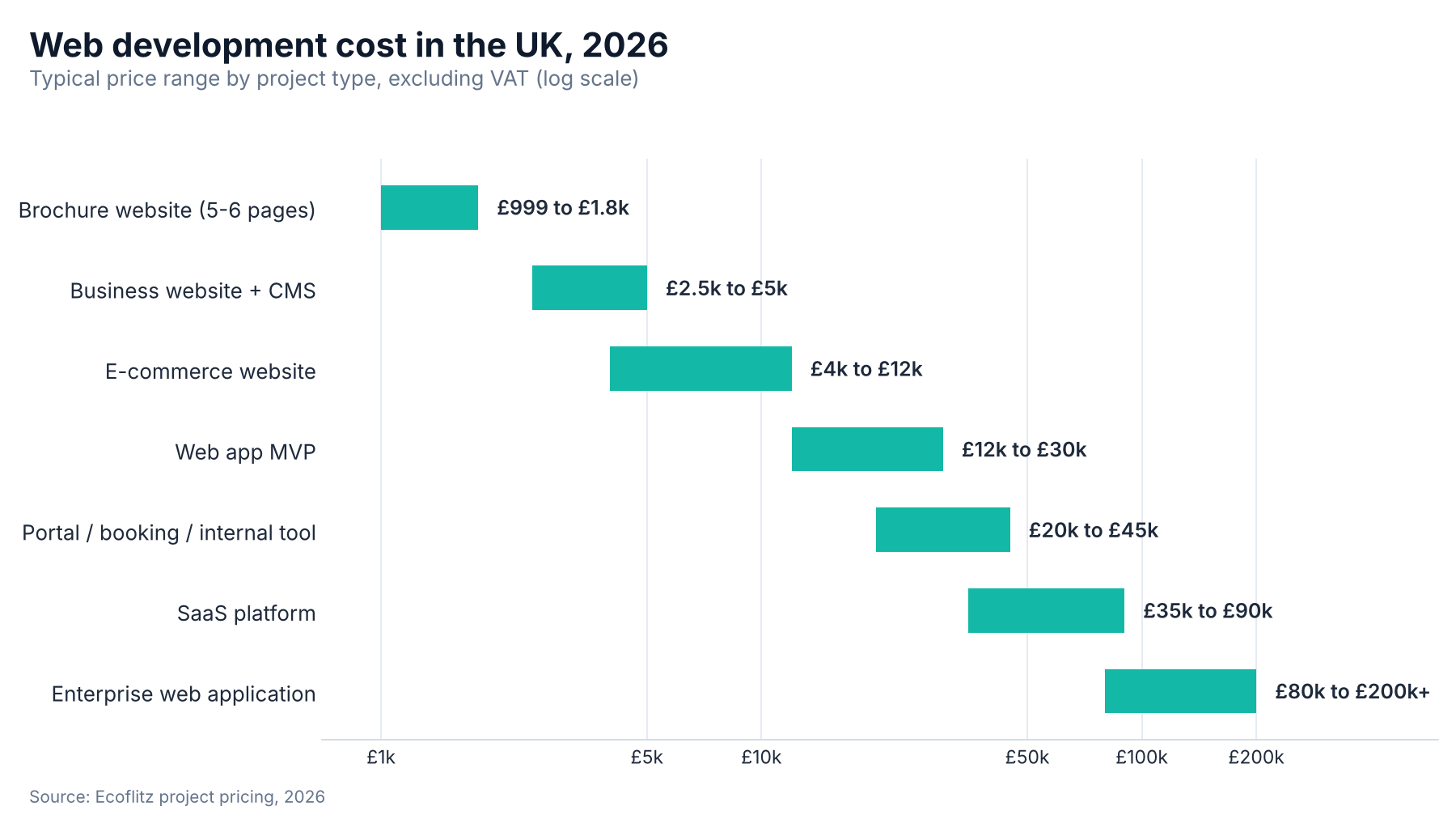
Here is what web projects typically cost in the UK in 2026, from a simple brochure site up to a full enterprise platform.
Brochure website (5 to 6 pages): From £999 (usually £999 to £1,800), 1 to 2 weeks
Business website with CMS and blog (10 to 15 pages): £2,500 to £5,000, 3 to 5 weeks
E-commerce website: £4,000 to £12,000, 4 to 8 weeks
Web app MVP: £12,000 to £30,000, 6 to 10 weeks
Customer portal, booking system or internal tool: £20,000 to £45,000, 8 to 14 weeks
SaaS platform: £35,000 to £90,000, 12 to 24 weeks
Enterprise web application: £80,000 to £200,000+, 5 to 9 months
That is a huge spread, from under a thousand pounds to well over six figures. The rest of this guide explains why, so you can work out where your project actually sits.
First, are you building a website or a web app?
People use these terms as if they mean the same thing. They don't, and the difference is the single biggest factor in what you will pay.
A website is mostly about showing information. Visitors read your pages, maybe fill in a contact form, maybe buy something from a shop. The content changes now and then, usually through a content management system so you can edit it yourself.
A web application is about doing things. Users log in. They have their own data. They book appointments, upload files, track orders, manage teams, pay subscriptions, run reports. Behind the screens there is a database, business logic, user permissions and often connections to other systems such as payment providers, CRMs or accounting software.
A good rule of thumb: if users need to log in and see something different from everyone else, you are probably building a web app. And web apps cost more because most of the work is invisible. The login page might take an afternoon to design. Making sure nobody can ever see another customer's data takes a lot longer than that.
Price by project type
Brochure website (5 to 6 pages): from £999
This is the classic small business website. Home, About, Services, maybe a page or two for specific services, and Contact. For most of these we charge £999, and it rarely goes above £1,800 unless there is something unusual in the brief.
For that price you should expect:
A custom design based on your branding, not a template with your logo dropped in
Mobile friendly layouts that work properly on phones and tablets
A contact form that actually reaches your inbox
Basic on-page SEO: page titles, meta descriptions, headings and fast loading
Google Analytics and Search Console set up
An SSL certificate and a cookie banner that meets UK GDPR rules
What pushes the price up? Writing the copy for you (we charge around £75 per page), extra pages (around £99 to £150 each), custom illustrations, booking widgets or multiple languages.
One honest note: if your budget is under £500, a DIY builder like Wix or Squarespace is probably a better fit than any agency. There is nothing wrong with that. Plenty of businesses start there and come to us later when they outgrow it.
Business website with a CMS and blog: £2,500 to £5,000
This is a step up for businesses that rely on their site for leads. You get more pages, a proper content management system so your team can publish blog posts and case studies, and more thought put into structure, conversion and search.
Typically this includes 10 to 15 page templates, a blog, case study or portfolio sections, lead capture forms connected to your CRM or email platform, and a technical SEO setup (schema markup, XML sitemap, redirects from any old site). Most of these take three to five weeks.
E-commerce website: £4,000 to £12,000
Online shops vary a lot. A small store on Shopify with a few dozen products and a customised theme sits at the lower end. A custom build with hundreds of products, product variants, trade accounts, subscriptions or integration with your stock system sits at the top, and can go beyond it.
Watch out for ongoing costs here. Platform subscriptions, paid apps and payment processing fees can add up to more than the build cost over a couple of years, so factor them in from day one.
Web app MVP: £12,000 to £30,000
An MVP, or minimum viable product, is the smallest version of your idea that real users can sign up to and actually use. It is not a demo or a clickable prototype. It runs in production, stores real data and becomes version one of your product.
A typical MVP we build includes user sign up and login, a dashboard, two or three core features that solve the main problem, an admin area, email notifications, and payments if the business model needs them. Six to ten weeks is normal.
The biggest mistake we see at this stage is trying to fit version three into the MVP budget. Every feature you add before launch is a guess about what users want. Launch with less, learn faster, then spend money on the features people actually ask for. If you are still testing the idea itself, our idea validation service is a much cheaper place to start.
Customer portal, booking system or internal tool: £20,000 to £45,000
These are the workhorses of a lot of businesses. A client portal where customers check orders and download invoices. A booking system for clinics or salons. An internal tool that replaces three spreadsheets and a lot of copy and pasting.
The price usually depends on how many user roles there are (customer, staff, manager, admin), how many systems it needs to talk to, and how much reporting you need. Integrations are often the hidden heavy lifting. Connecting to a modern API like Stripe is straightforward. Connecting to an old on-premise system with no documentation is not.
SaaS platform: £35,000 to £90,000
Software as a service products have extra layers that a single business tool does not need. Multiple companies use the same platform, so you need multi-tenancy, which means keeping every customer's data properly separated. You need subscription billing, plan limits, trial periods, team invites, onboarding flows and usually a fair amount of analytics.
Most founders we work with build a SaaS in stages: an MVP first, then a series of releases over the following months. That spreads the cost and means each round of spending is based on real customer feedback.
Enterprise web application: £80,000 to £200,000+
At the enterprise end, the code is often not the most expensive part. Single sign-on, audit trails, role based permissions, data retention policies, penetration testing, accessibility compliance, procurement paperwork and integration with several existing systems all take real time. So does coordinating with in-house IT, security and legal teams.
These projects are almost always priced after a paid discovery phase, because nobody can quote a six figure build accurately from a two page brief.
Where your money actually goes
When people see a quote of £24,000 for a booking system, the natural reaction is "for what?" So here is how a typical web app budget breaks down. This is an illustrative example based on a booking portal for a multi-site clinic, the kind of project we quote regularly.
Discovery and scoping: Workshops, user journeys, technical plan, fixed scope, £1,800
UX and UI design: Wireframes, clickable prototype, final designs for every screen, £3,500
Frontend development: Building the screens patients and staff use, on desktop and mobile, £6,500
Backend and database: Booking logic, availability rules, user accounts, permissions, admin, £7,000
Integrations: Stripe payments, calendar sync, email and SMS reminders, £2,400
Testing and QA: Manual and automated testing, security checks, bug fixing, £2,200
Launch and handover: Deployment, monitoring, training, documentation, £800
Total: £24,200
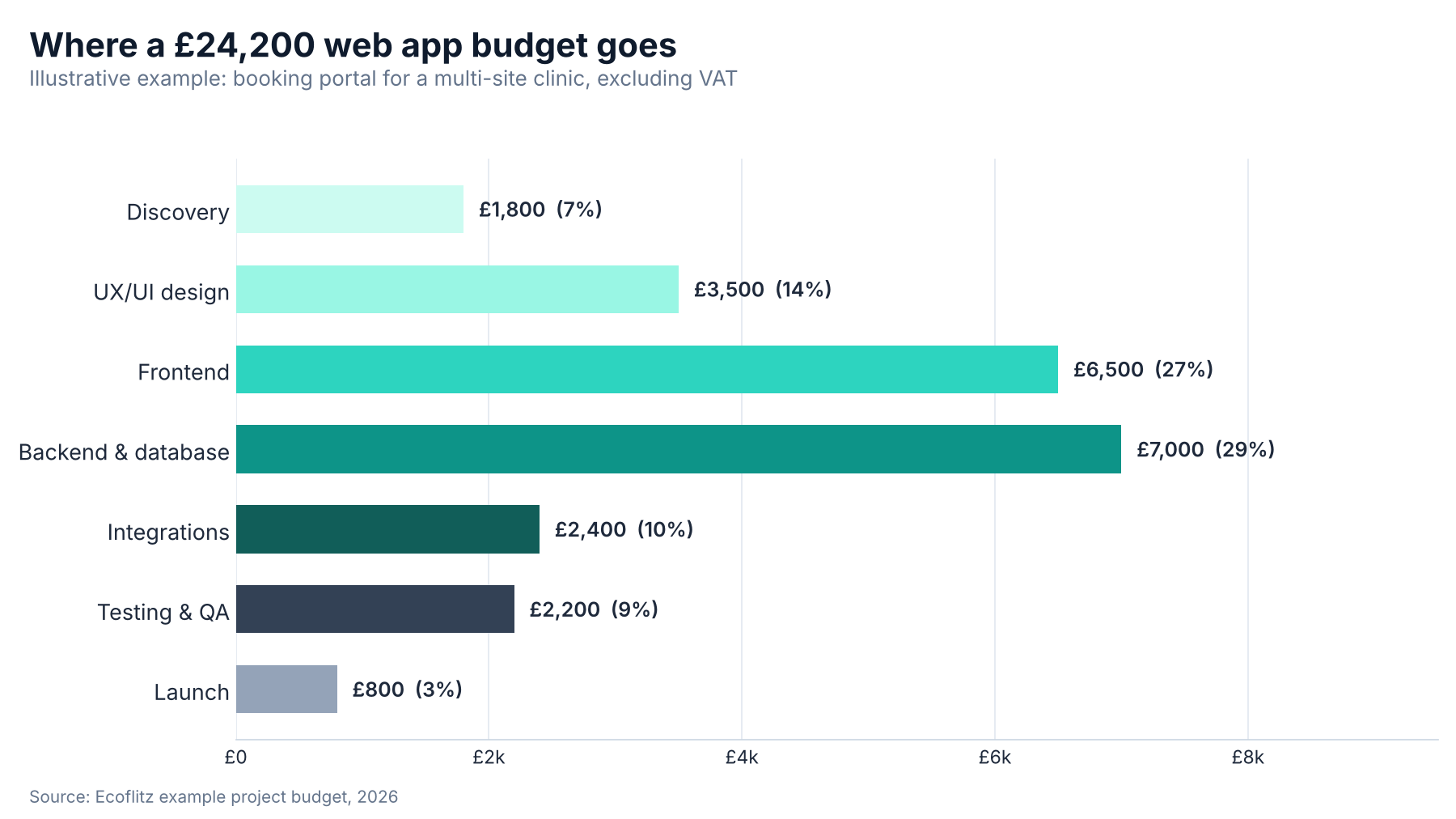
Notice that frontend and backend development together make up more than half the budget, and that testing gets nearly ten percent. If a quote you receive has no line for testing at all, ask why. It does not mean the agency skips it. It usually means the cost is hidden somewhere else, or worse, that you will be the one finding the bugs after launch.
What drives the price up (or down)
1. The number of features, and how complicated each one is
"Users can book an appointment" sounds like one feature. In reality it is a dozen: checking availability, handling time zones, blocking double bookings, cancellations, reschedules, reminders, refunds, staff holidays. The more rules your business has, the more time it takes to build them properly. A clear list of what is in scope, and just as importantly what is out of scope, is the best tool you have for controlling cost.
2. Custom design versus a design system
A completely bespoke interface with custom illustrations and animations looks great and costs more. Building on a proven component library still looks professional and cuts design and frontend time noticeably. For internal tools especially, we usually recommend the second option.
3. Integrations
Every system your app talks to adds work: payment providers, CRMs, accounting tools, mapping, messaging, AI models. Well documented modern APIs are quick. Legacy systems, unusual file formats and providers with patchy documentation are slow, and slow means expensive.
4. Security and compliance
If you handle personal data, and almost every web app does, you have obligations under UK GDPR. If you are in health, finance or working with the public sector, the bar is higher again. Secure authentication, encryption, audit logs and a penetration test before launch all add to the budget. They are also far cheaper to build in from the start than to bolt on after a problem. Our cybersecurity team works alongside developers on every build for exactly this reason.
5. Who builds it, and where they are
Day rates vary a lot across the UK market. As a rough guide from the quotes clients share with us:
• Freelance developers: roughly £250 to £500 a day
• Regional UK agencies: roughly £450 to £750 a day
• London agencies: roughly £600 to £1,000+ a day
• Offshore teams: often much lower day rates, though management overhead, time zones and rework can close the gap
A cheaper day rate does not always mean a cheaper project. A senior developer who knows the problem can finish in three days what a junior takes ten to do, and the code will be easier to maintain. Compare total project cost and the quality of the team, not just the rate.
6. Adding AI features
More and more of the projects we quote include some AI: a chatbot trained on your own documents, automatic categorisation, summaries, or smart search. Expect to add roughly £5,000 to £25,000 depending on how deep it goes, plus ongoing usage costs from the AI provider. We cover this properly on our AI solutions page.
How long will it take?
Timelines matter for cost because most agencies, including us, price based on the time a team spends on your project. Here is what is realistic for each type of build, assuming feedback comes back promptly.
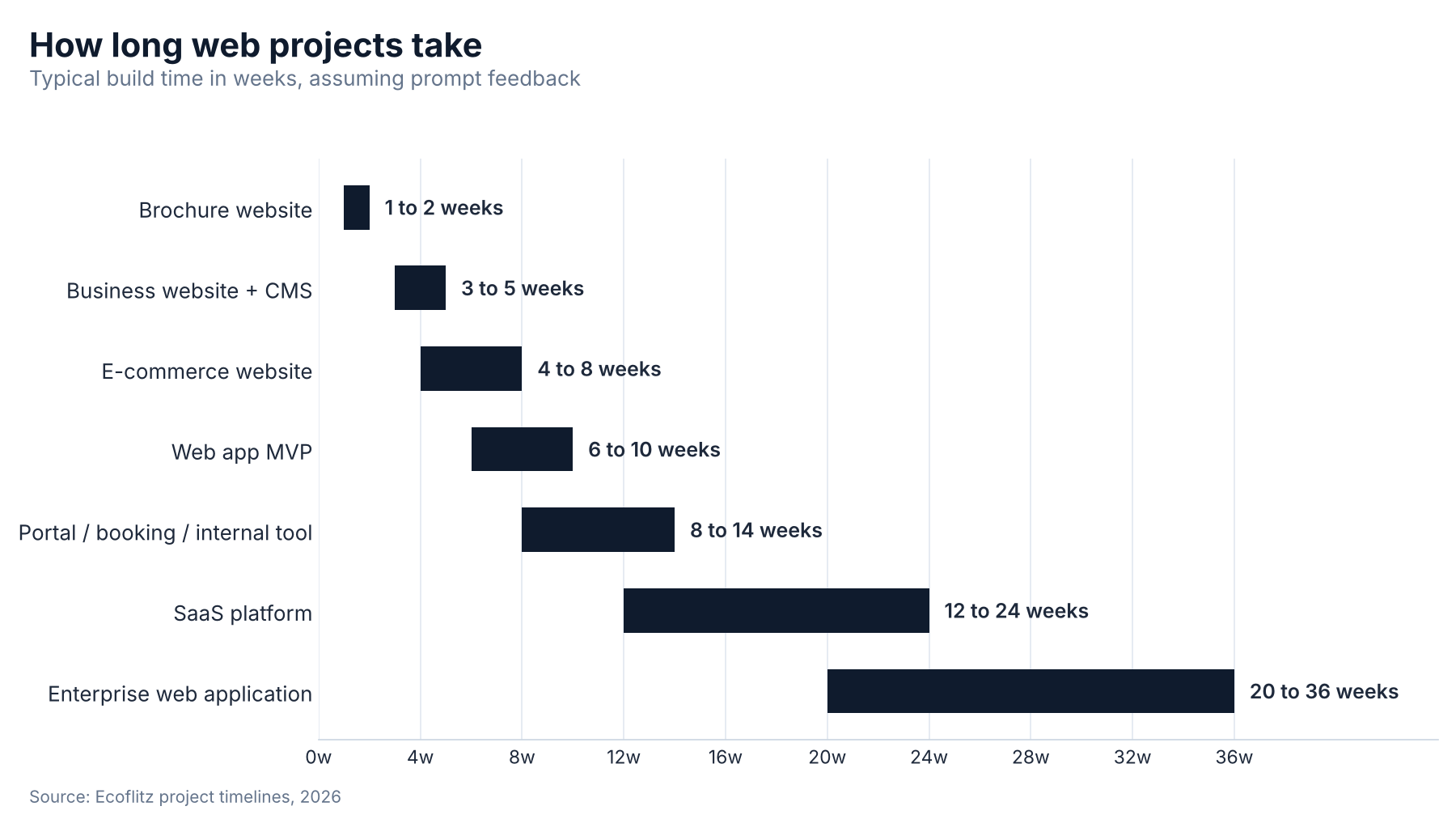
The quickest way to stretch a timeline, and the budget with it, is slow decisions. A week waiting for sign off on designs is a week the team either sits idle or switches to another project and loses momentum. Agree who makes decisions on your side before work starts.
The running costs nobody mentions in the quote
The build is a one-off. Your site or app then has to live somewhere, stay secure and keep working as browsers, phones and third party services change. Here is what to budget each year.
Hosting: £10 to £30 a month, £50 to £500+ a month, depending on users
Domain name: £10 to £20 a year, £10 to £20 a year
Maintenance and support: From £49 a month, Around 15 to 20 percent of the build cost a year
Third party services: Email marketing, forms, plugins, Payments, email, SMS, maps, AI usage, monitoring
Security testing: Usually not needed, A penetration test once a year is good practice
Maintenance is the one people try to skip, and it is the one they regret skipping. Software that nobody updates slowly breaks and becomes a security risk. Our support and maintenance plans cover updates, monitoring, backups and small changes, so you are not paying emergency rates when something goes wrong.
Hidden costs worth asking about
Before you sign anything, ask every agency you speak to about these. A good one will answer straight away.
Content. Who writes the copy and sources the images? If it is you, block out the time now, because waiting for content is the most common reason websites launch late.
Change requests. What happens if you want to add something halfway through? Is there a day rate for changes, and how are they approved?
Who owns the code? You should own the code and the intellectual property once you have paid. Get it in writing.
Hosting accounts. Is your app hosted in an account you control, or the agency's? If you part ways, can you take it with you easily?
Licences. Paid themes, plugins, fonts, icon sets and software libraries can carry yearly fees.
Post launch fixes. Is there a warranty period for bugs? We include 30 days on every project, and you should expect something similar.
How to keep the cost down without cutting corners
You do not have to spend less on quality to spend less overall. Here is what genuinely saves money:
1. Write down your must haves. Split your feature list into "launch without it and we fail" and "nice to have". Build the first list. Park the second.
2. Pay for discovery first. A short paid scoping phase costs a fraction of the build and gives you a fixed scope, a clear price and a plan you can take to any agency. It is the best value money in the whole project.
3. Use proven tools where you can. There is no need to build your own payments, login or email system from scratch. Good existing services exist for all of them.
4. Start with web, then go mobile. A well built responsive web app works on phones. Many products do not need native iOS and Android apps until they have proven demand. Our guide to mobile app development costs in the UK explains when going native makes sense.
5. Be quick with feedback. It sounds small. It is not. Fast decisions are one of the biggest savings available to you.
6. Plan in phases. Launch version one, then release improvements every few weeks. You spread the cost and every pound after launch is guided by real users.
How to compare quotes
If you get three quotes and they range from £8,000 to £40,000 for the same brief, that is normal, and it does not automatically mean someone is ripping you off. Usually they have each understood the brief differently. Here is how to compare them fairly:
Check that each quote lists the same features. Ask the cheapest one what is not included.
Look for testing, project management, deployment and post launch support as separate lines.
Ask who will actually do the work, and whether it is in-house or subcontracted.
Ask to see similar projects they have built, and if possible speak to a past client.
Check whether the price is fixed or time and materials, and what happens if the estimate is wrong.
Be careful with a quote that is far below the others. Very low prices often come from teams who will cut corners on security and testing, or who plan to make the money back on change requests later.
Frequently asked questions
How much does a 5 page website cost in the UK?
A professionally designed 5 to 6 page brochure website typically costs from £999 to £1,800 with an agency like ours. DIY builders cost less upfront but you do the work yourself, and freelancers vary widely in both price and quality.
How much does it cost to build a web app in the UK?
Most web apps cost between £12,000 and £45,000. A focused MVP sits at the lower end, while portals and internal tools with several user roles and integrations sit at the higher end. SaaS platforms and enterprise systems cost more.
Is it cheaper to build a web app or a mobile app?
A web app is usually cheaper because you build one product that works in every browser, instead of separate apps for iOS and Android. It also avoids app store fees and review delays. Many businesses start with web and add mobile apps later.
What are the monthly costs after a website goes live?
For a typical small business website, expect around £20 to £80 a month for hosting and a basic maintenance plan. Web apps cost more to run, often a few hundred pounds a month once you include hosting, monitoring, third party services and support.
Do I need to pay VAT on web development?
If your developer or agency is VAT registered, they will add 20 percent VAT to their prices. If your business is VAT registered too, you can usually reclaim it. All the prices in this guide exclude VAT.
Can I get a fixed price for my project?
Yes, as long as the scope is clear. We give fixed prices for websites and for web apps once a discovery phase has pinned down exactly what is being built. For projects where requirements are likely to change, a time and materials model with a budget cap is often fairer for both sides.
So what will your project cost?
If you have read this far, you probably have a rough idea of where your project sits. The next step is turning that into a real number based on what you actually need.
Tell us what you are trying to build, and we will come back with an honest estimate, including the running costs, usually within two working days. No pressure, and no "it depends" without an explanation of what it depends on.
Book a free consultation or take a look at projects we have delivered to see the kind of work behind these numbers.
The Ecoflitz development team — writing about AI, cybersecurity, software engineering, and the future of technology.