How Much Does an MVP Cost in the UK? Budgets, Timelines and What to Cut (2026)
Planning an MVP in the UK? Here is what it really costs, from £499 validation pages to £30,000 coded products, how long it takes, and the features you can safely leave out so your budget goes on what proves your idea.

Most founders we speak to have one number in their head before they have a product. Sometimes it is the money they have saved. Sometimes it is what an angel investor has offered. Sometimes it is just a figure that felt reasonable after an evening of googling. The question is always the same: is it enough to build an MVP?
This guide gives you a straight answer. We will walk through what an MVP actually costs in the UK right now, what you get at each budget level, how long it takes, and, most importantly, what you can cut so your money goes on the things that prove your idea works.
All prices are in pounds and exclude VAT. They come from the projects we quote and build, plus the quotes founders regularly show us from other agencies and freelancers.
The short answer
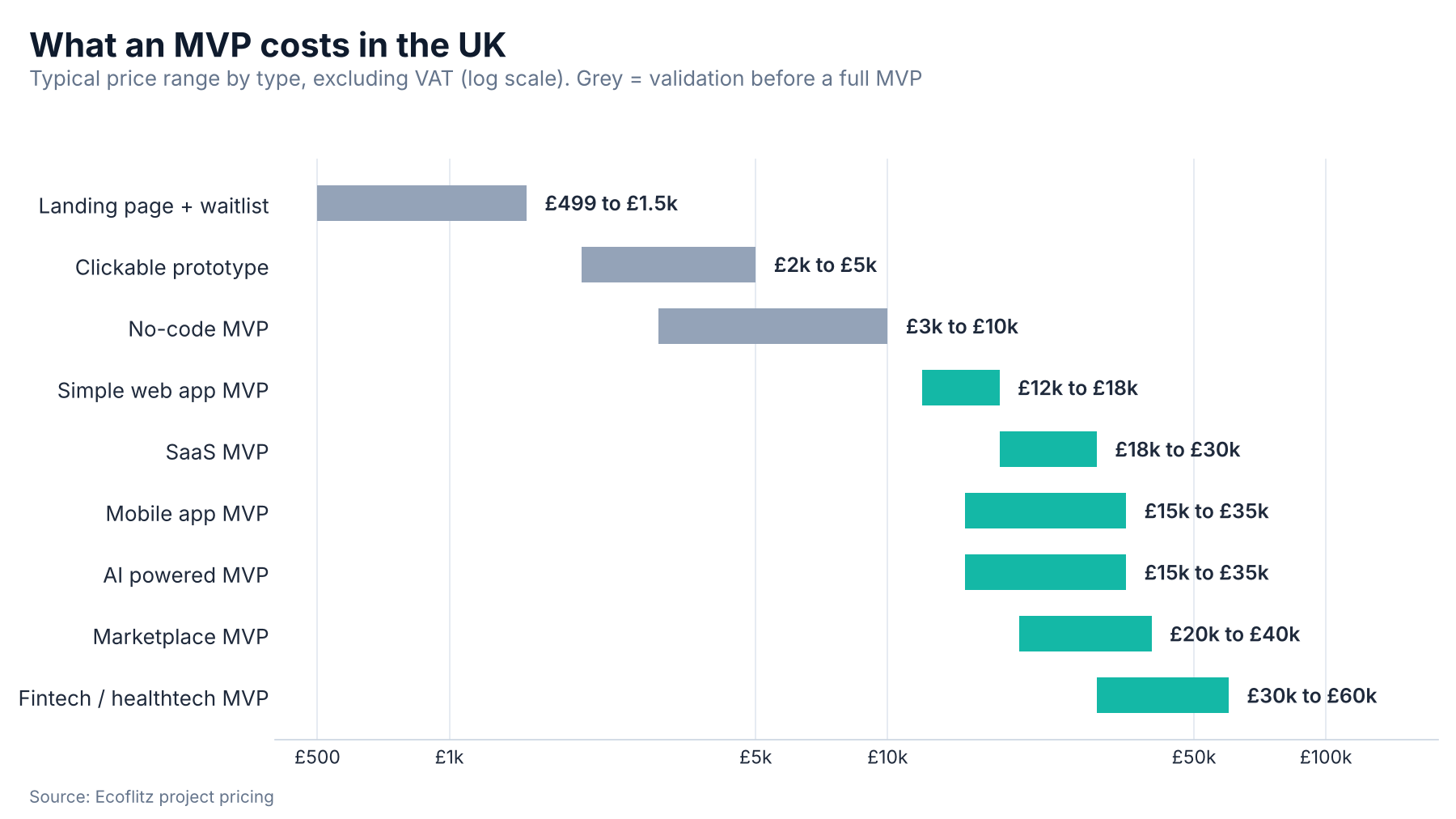
A typical MVP built by a UK agency costs between £12,000 and £30,000 and takes six to ten weeks. A simpler product can come in under that. A product that handles money, health data or two sides of a marketplace usually costs more.
Here is how it breaks down by type:
• Landing page and waitlist (testing demand, not an MVP yet): £499 to £1,500, about 1 week
• Clickable prototype (looks real, does not store data): £2,000 to £5,000, 1 to 3 weeks
• No-code MVP (built with tools like Bubble or Glide): £3,000 to £10,000, 2 to 5 weeks
• Simple web app MVP: £12,000 to £18,000, 6 to 8 weeks
• SaaS MVP with subscriptions: £18,000 to £30,000, 8 to 10 weeks
• Mobile app MVP (iOS and Android from one codebase): £15,000 to £35,000, 8 to 12 weeks
• AI powered MVP: £15,000 to £35,000, 6 to 12 weeks
• Two sided marketplace MVP: £20,000 to £40,000, 10 to 14 weeks
• Fintech or healthtech MVP with compliance work: £30,000 to £60,000, 12 to 16 weeks
If you are looking at that list and thinking "I just want to know if people will pay for this", skip ahead to the section on validating before you build. It might save you most of your budget.
What an MVP actually is (and what it is not)
The term gets stretched a lot, so it is worth being clear.
A minimum viable product is the smallest version of your idea that real users can sign up to, use for its main purpose, and ideally pay for. It runs on real servers, stores real data and becomes version one of your product. You do not throw it away. You build on it.
It is not a prototype. A prototype is a set of designs you can click through. It is brilliant for showing investors and for testing whether people understand your idea, but nobody can actually use it to get anything done.
It is also not a cut down version of everything you have planned. This is the mistake that eats budgets. An MVP is not ten features built badly. It is two or three features built properly, the ones that solve the main problem for your first users.
A useful test we give founders: if you removed this feature, would your first ten customers still get value from the product? If the answer is yes, it does not belong in the MVP.
What you get at each budget
Under £5,000
At this level you are not building a full product, and that is fine. Your money is best spent proving demand. That might be a landing page that explains the idea and collects sign ups, a clickable prototype you put in front of potential customers, or a short paid discovery phase that turns your idea into a clear plan and a fixed quote.
Plenty of successful products started exactly like this. If 200 people join a waitlist in a month, you have something to show investors. If ten people join, you have saved yourself £20,000.
£5,000 to £12,000
This is no-code territory, or a very tightly scoped coded product. Tools like Bubble, Glide or Softr let you launch something that works surprisingly well, especially for internal tools, directories and simple booking or matching products.
The trade off is control. No-code platforms have limits on performance, custom logic and how much you can scale. You also pay a monthly fee forever and cannot easily take your product elsewhere. For testing an idea, that is often a fair deal. For a product you want to raise serious money on, it can become a problem.
£12,000 to £30,000
This is where most agency built MVPs land, and where you get a proper coded product you own outright. A typical build at this level includes:
• Sign up, login and password reset
• User profiles and account settings
• Two or three core features that deliver the main value
• An admin area so you can manage users and content
• Email notifications
• Payments through Stripe if your model needs them
• Basic analytics so you can see how people use it
• Hosting set up, security basics and a launch plan
It is built on a modern stack that a future in-house team can pick up. For our projects that is usually Next.js, Node.js and a PostgreSQL database, but the specific tools matter less than whether the code is clean and documented.
£30,000 and above
You end up here for one of a few reasons. The product has two sides that both need their own experience, like a marketplace with buyers and sellers. It needs native mobile apps from day one. It handles money or health data and has regulatory work to do. Or it relies on complex integrations with existing systems.
None of these are bad reasons. But if your MVP quote has crept over £30,000 and you are not sure why, ask for a breakdown by feature. Often there are two or three items in there that could wait until after launch.
A real example: what a £24,000 MVP looks like
Here is an illustrative example based on the kind of project we quote often. A founder wants to build a scheduling platform for small cleaning companies. Business owners assign jobs to their staff, customers book online, and everyone gets reminders.
This is what went into the MVP:
• Discovery and scoping: £1,200
• UX and UI design: £3,000
• Sign up, login and accounts: £1,500
• Teams and staff roles: £1,800
• Job scheduling and calendar (the core feature): £5,500
• Customer booking page: £3,000
• Stripe payments: £2,000
• Email and SMS reminders: £1,400
• Admin dashboard: £2,200
• Testing and QA: £1,800
• Launch and handover: £600
• Total: £24,000
And this is what we agreed to leave until after launch:
• Native iOS and Android apps: about £15,000
• AI route planning between jobs: about £8,000
• Advanced reporting: about £4,000
• Custom animations and a bespoke design system: about £3,000
• Xero integration: about £2,500
• Multiple languages: about £2,000
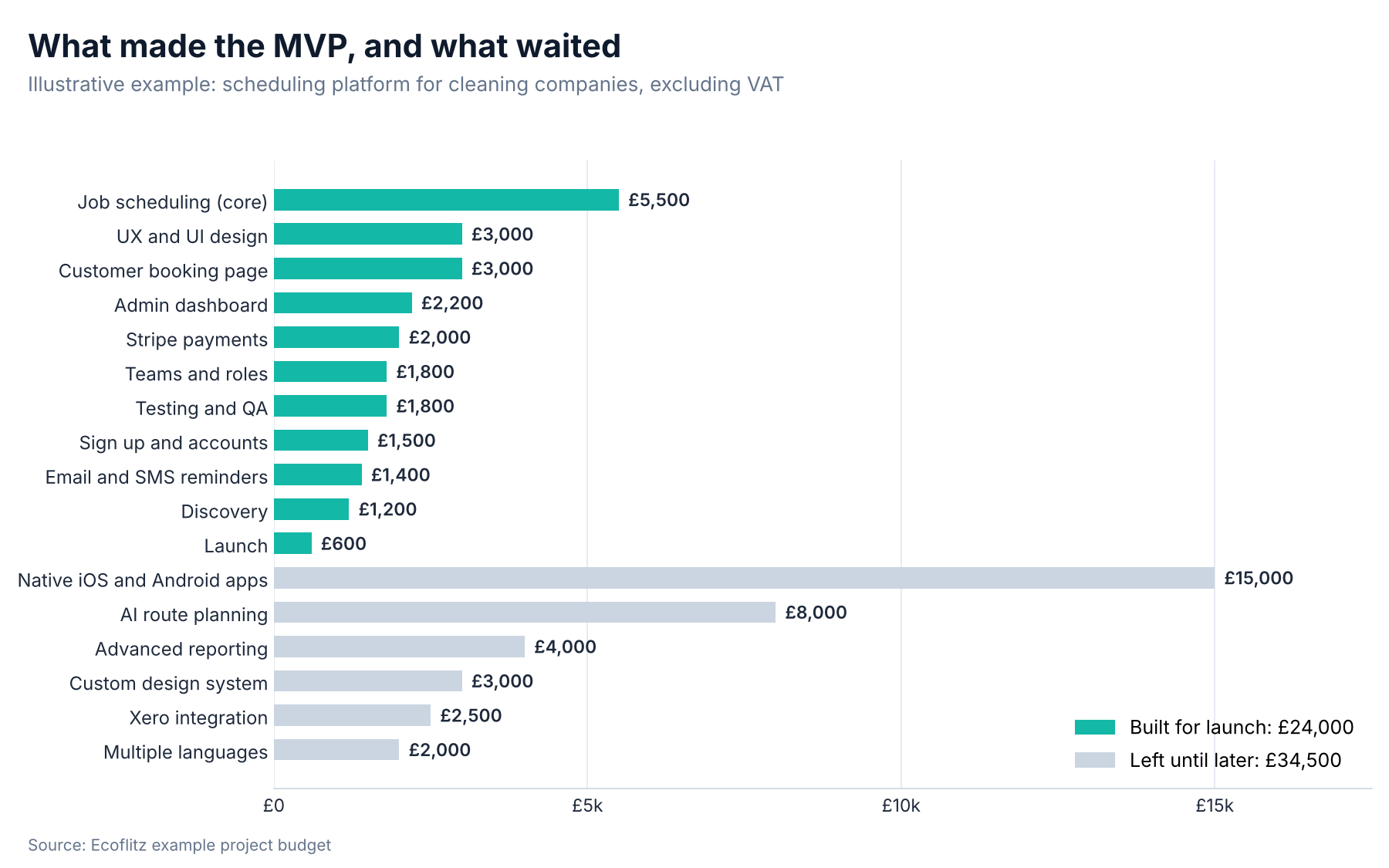
That list of "later" features adds up to £34,500. It is more than the MVP itself. Every one of those features is a good idea. None of them is needed to find out whether cleaning companies will pay for the core product. The web app works fine on phones, owners can export data to a spreadsheet for now, and the founder can add the rest once paying customers tell them what matters most.
That is the difference between an MVP that launches in eight weeks for £24,000 and one that launches in six months for £60,000.
What drives MVP cost up
The number of user types
Every type of user needs their own screens, permissions and journeys. A product for one type of user (say, freelancers managing their invoices) is much cheaper than one with customers, staff, managers and admins all doing different things. Marketplaces are expensive for exactly this reason: you are really building two products that have to work together.
Payments and money movement
Taking a simple subscription payment through Stripe is straightforward. Holding money on behalf of users, splitting payments between parties, handling refunds and disputes, or anything that needs FCA authorisation is a different level of work. If your product touches money in a complex way, budget for it properly and get advice early.
Native mobile apps
If your users genuinely need a phone app from day one, for example because they work out in the field or you rely on push notifications and the camera, then it is worth it. But building iOS and Android apps adds a lot of cost, and app store reviews add delays. Many products launch as a responsive web app first and go native once they have traction. Our guide to mobile app development costs in the UK goes into this in detail.
AI features
Adding AI to an MVP is easier and cheaper than it used to be, but it is not free. A chatbot that answers questions from your own documents, smart categorisation or automatic summaries can add £5,000 to £20,000, plus a monthly bill from the AI provider that grows with usage. The bigger cost is often testing: making sure the AI gives reliable, safe answers takes time.
Compliance and security
If you handle personal data, you need to follow UK GDPR. If it is health data, financial data or children's data, expect extra requirements and possibly a penetration test before launch. Building security in from the start is far cheaper than fixing it after a problem, and investors increasingly ask about it during due diligence.
Integrations with other systems
Connecting to well documented services is quick. Connecting to old systems, industry specific software or anything without a proper API can take longer than building the features themselves. If your MVP depends on a particular integration, check it is technically possible before you commit to the rest.
How long does an MVP take?
For a typical agency built MVP, plan on six to ten weeks from the start of design to launch. Here is how that time usually splits:
• Weeks 1 to 2: discovery, scoping, wireframes and designs
• Weeks 3 to 7: development in short cycles, with a demo you can click through every week or two
• Week 8: testing, fixes, final security checks
• Weeks 9 to 10: launch, monitoring and the first round of small improvements
What makes it slower? Changing your mind about core features halfway through, slow feedback on designs, waiting for content or legal text, and integrations that turn out to be harder than expected. Agree on who makes decisions on your side before work starts, and keep that person available.
Agency, freelancer, no-code or do it yourself?
There is no single right answer. It depends on your skills, your budget and how much risk you can live with.
Building it yourself with AI tools
AI coding tools have made it possible for non developers to build working prototypes. If you have the time, this is a great way to test an idea and learn a lot about what you are building. The catch is that what you end up with is often hard to maintain, insecure in ways you will not spot, and difficult for a professional developer to take over. Treat it as a prototype, not a foundation.
Hiring a freelancer
A good freelancer can be excellent value, especially for simpler products. The risks are that one person is a single point of failure, they may be strong in some areas and weaker in others (design, security, testing), and you take on the project management yourself.
Using a no-code platform
Quick and cheap for the right kind of product. Watch the limits on scale and custom logic, and the long term monthly cost.
Working with an agency
More expensive per day, but you get a full team: design, development, testing, project management and security under one roof, with someone accountable for the whole thing. For founders who are raising money or selling to businesses, a professionally built product is often easier to sell and to hand over to an in-house team later.
The running costs after launch
Founders often budget for the build and forget the year after it. Plan for these:
• Hosting and infrastructure: £50 to £300 a month for most MVPs
• Email, SMS and other third party services: £20 to £200 a month depending on usage
• AI usage, if you have AI features: anywhere from £20 to several hundred pounds a month
• Maintenance and support: around 15 to 20 percent of the build cost a year
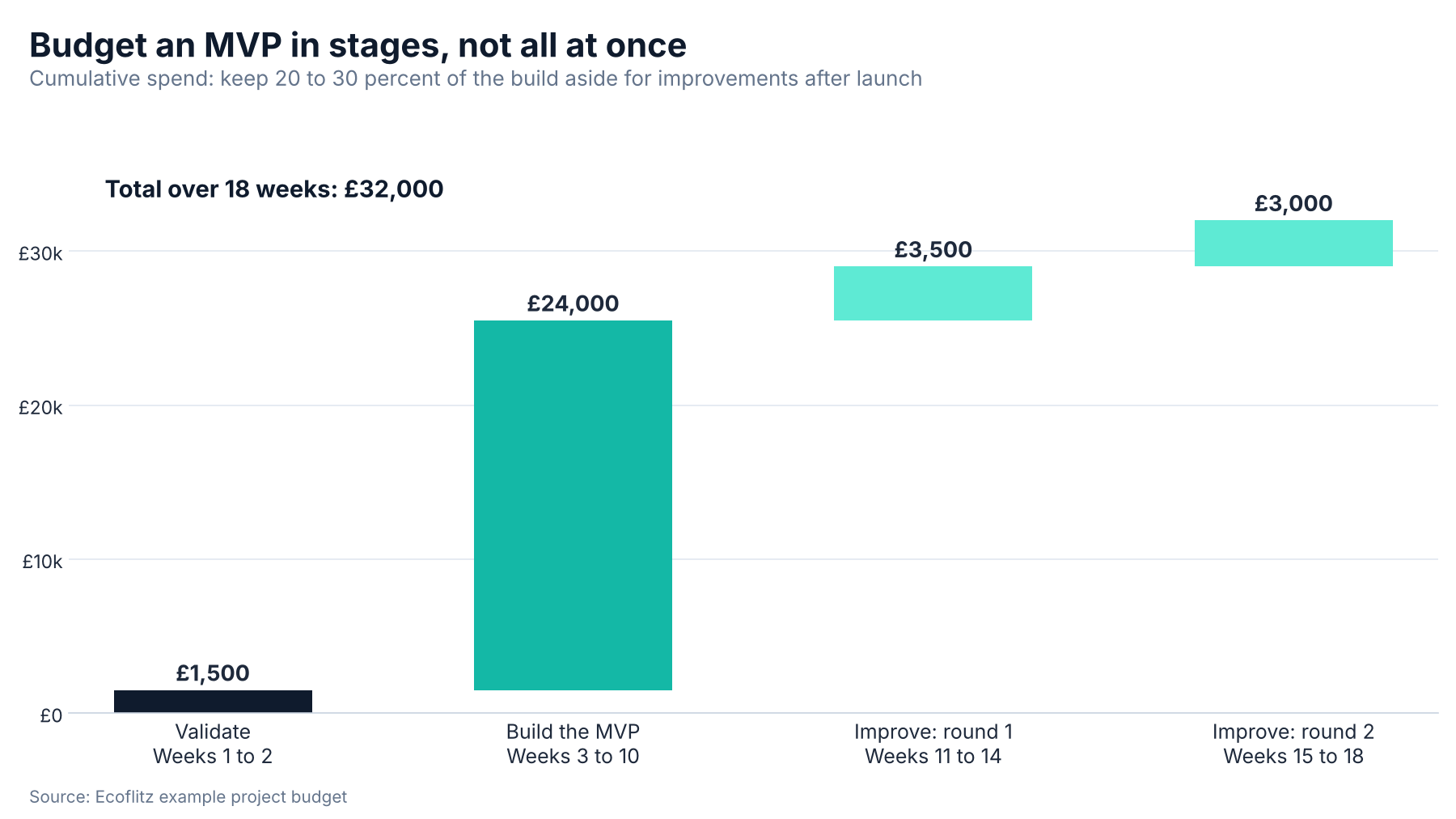
• Small improvements after launch: we suggest keeping 20 to 30 percent of your build budget aside for the first three months
That last one matters more than people expect. Your first users will tell you things you could not have known. If all your money went on the launch, you cannot act on what they say.
How to spend less without building something worse
1. Validate before you build. Talk to 20 potential customers. Put up a landing page. Run a small ad campaign. Pre sell if you can. A few hundred pounds here can save tens of thousands later.
2. Pick one main job. Write down the single most important thing your product helps people do. Every feature in the MVP should support that job.
3. Do things manually at first. You do not need an automated matching algorithm if you can match your first 50 users by hand in a spreadsheet. Automate once you know the process works.
4. Use existing services. Do not build your own login, payments, email or chat. Proven services exist for all of them and they are cheaper and more secure than anything you would build from scratch.
5. Start with a web app. A well built responsive web app works on every phone and avoids app store delays. Go native when your users ask for it.
6. Pay for discovery. A short scoping phase gives you a fixed scope and a fixed price. It is the best protection you have against an MVP that slowly grows into something you cannot afford.
7. Plan for phase two from day one. Budget your money in stages: validate, build the MVP, then improve based on real feedback. That way you never spend everything on a guess.
Red flags when getting MVP quotes
• A price given after a ten minute call with no written scope
• No mention of testing, security or what happens after launch
• You do not own the code, or it is hosted in an account you cannot access
• Every feature on your wish list is included without any pushback
• A quote far below everyone else's with no clear reason why
That fourth point surprises people. A good partner should question your feature list. If nobody is asking "do you really need this for launch?", they are either not thinking about your budget or they are happy to bill you for it.
Frequently asked questions
How much does an MVP cost in the UK?
Most agency built MVPs in the UK cost between £12,000 and £30,000. No-code MVPs can cost £3,000 to £10,000, while marketplaces and regulated products like fintech or healthtech often cost £30,000 to £60,000.
Can I build an MVP for under £10,000?
Yes, if you keep the scope very tight or use no-code tools. You could also spend that money on validation and a clickable prototype first, which is often the smarter move if you have not yet proven people want the product.
How long does it take to build an MVP?
Six to ten weeks is typical for a coded MVP built by an agency. No-code MVPs can launch in two to five weeks, while more complex products such as marketplaces or regulated apps can take three to four months.
Should my MVP be a web app or a mobile app?
For most products, start with a responsive web app. It is cheaper, faster to launch and easier to update. Go native first only if your product depends on things like the camera, location tracking, offline use or push notifications.
Do I own the code for my MVP?
You should. Make sure your contract says that the code and intellectual property transfer to you once you have paid, and that your product is hosted in accounts you control.
Can I get R&D tax relief on my MVP?
Some software development can qualify for R&D tax relief in the UK if it involves genuine technical uncertainty. The rules have changed in recent years and not every project qualifies, so speak to an accountant who specialises in R&D claims before you count on it.
What should I do next?
If you have an idea and a rough budget, the next step is turning them into a plan. We can help you work out what belongs in your MVP, what can wait, and what it will realistically cost to build and run.
Tell us about your idea and we will come back with an honest view, including whether we think you should build yet. Sometimes the best advice is to validate first, and our idea validation service exists for exactly that.
Book a free consultation, or have a look at our portfolio to see the kind of products we have taken from idea to launch.
The Ecoflitz development team — writing about AI, cybersecurity, software engineering, and the future of technology.